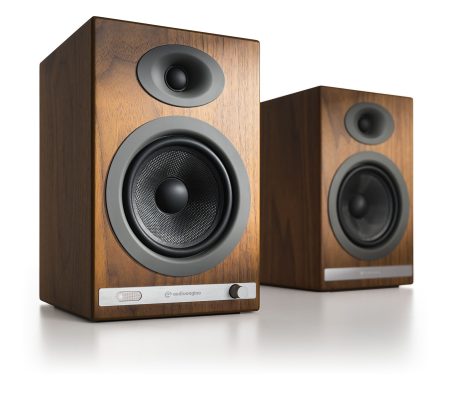

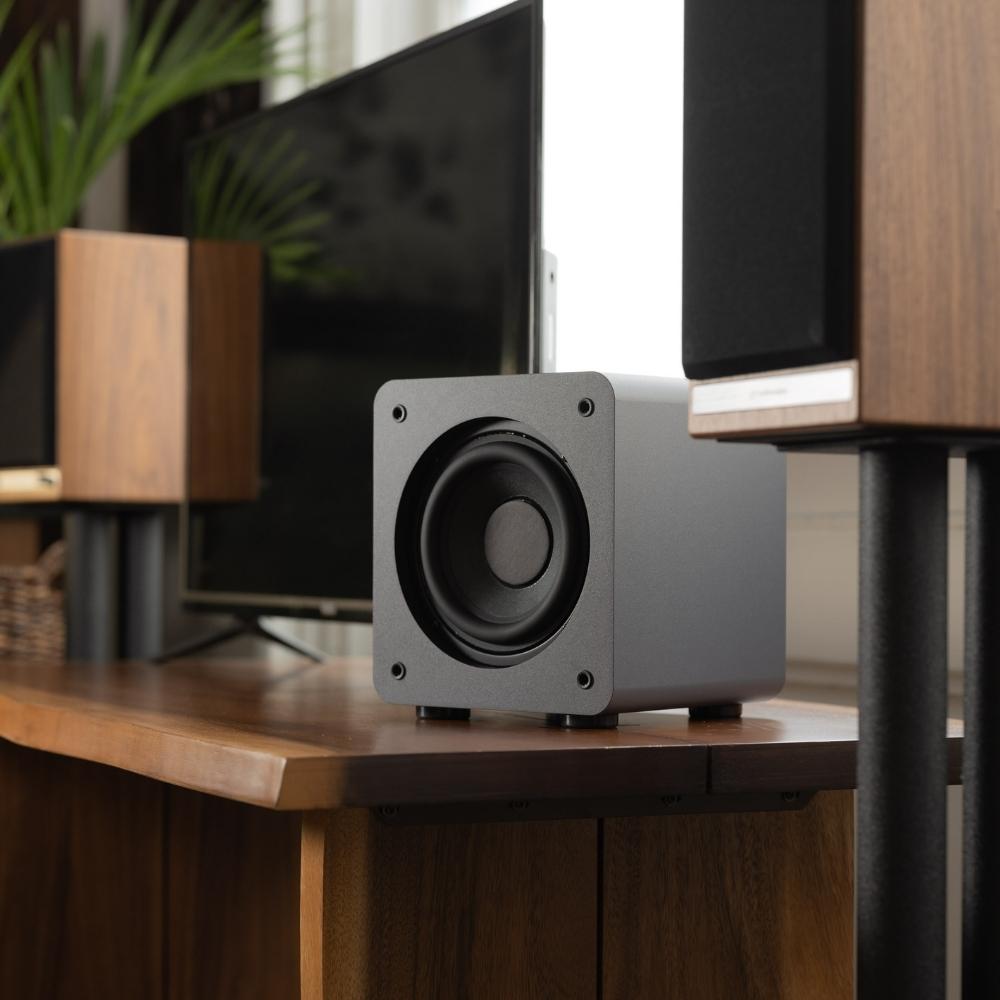
What if your speakers are leaving out up to 20% of your music?
Every song contains layers of sound, from vocals and guitars to kick drums, bass lines, and deep electronic frequencies. The problem is that many desktop and bookshelf speakers can’t reproduce the lowest frequencies in a recording.
That means you could be missing a significant part of the music you listen to every day.
Adding a subwoofer helps fill that gap by reproducing the low frequencies your speakers can’t fully deliver. The result is deeper bass, more accurate instrument reproduction, and a fuller listening experience.
The Science Behind the Missing 20%
To understand why a subwoofer matters, it helps to understand how sound works.
Sound is measured in frequencies called hertz (Hz). Human hearing generally spans from 20Hz to 20,000Hz. Different instruments produce different frequencies, and each contributes to the overall sound of a recording.
Here’s where bass fits into the picture:
- 20–60Hz: Deep bass from electronic instruments, synthesizers, and the lowest musical notes.
- 60–120Hz: Kick drums, bass guitars, and the low-frequency impact that drives a song.
- 120–250Hz: Upper bass frequencies responsible for warmth and fullness.
Most compact speakers are designed to reproduce a broad range of frequencies, but their smaller drivers limit how much deep bass they can produce.
When those lower frequencies aren’t reproduced, you’re missing musical information that was part of the original recording.
Why You Need a Subwoofer for Music
A common misconception is that subwoofers are only useful for people who want extremely loud bass.
In reality, a good subwoofer is just as valuable when listening at moderate volumes.
Consider a song built around a bass guitar. The instrument produces fundamental notes and higher harmonics. Smaller speakers may reproduce enough harmonics for you to recognize the notes while missing much of their lower-frequency weight.
A subwoofer reproduces those deeper frequencies, allowing you to hear more of the instrument’s intended sound.
The difference is especially noticeable across several genres:
- Rock: More weight behind the bass guitar and kick drum.
- Hip-hop: Deeper bass notes that are central to the production.
- Electronic: Low-frequency synthesizers and bass lines that smaller speakers may struggle to reproduce.
- Jazz: Greater depth and body from upright bass instruments.
- Classical: More low-frequency detail from orchestral bass instruments and percussion.
If your speakers aren’t reaching these frequencies, you’re not getting the full range of sound contained in the recording.
How a Subwoofer Adds Up to 20% More Music
A subwoofer is specifically engineered to reproduce bass frequencies, typically focusing on the lower portion of the audible spectrum.
Unlike smaller speaker drivers, subwoofers use larger drivers, dedicated amplification, and cabinets designed to move the air needed to produce low-frequency sound.
For example, a compact speaker might begin losing substantial output below 65Hz. A subwoofer capable of reaching 33Hz can reproduce much of the low-frequency information that speaker cannot.
That’s important because bass frequencies aren’t limited to adding volume. They contribute to the tonal balance, instrument accuracy, and overall presentation of a recording.
Adding a properly configured subwoofer extends the frequency range of your speaker setup, allowing it to reproduce musical content that would otherwise be reduced or missing.
For listeners using compact speakers, that additional bass extension can represent a meaningful increase in how much of their music they hear.
How to Set Up a Subwoofer for the Best Sound
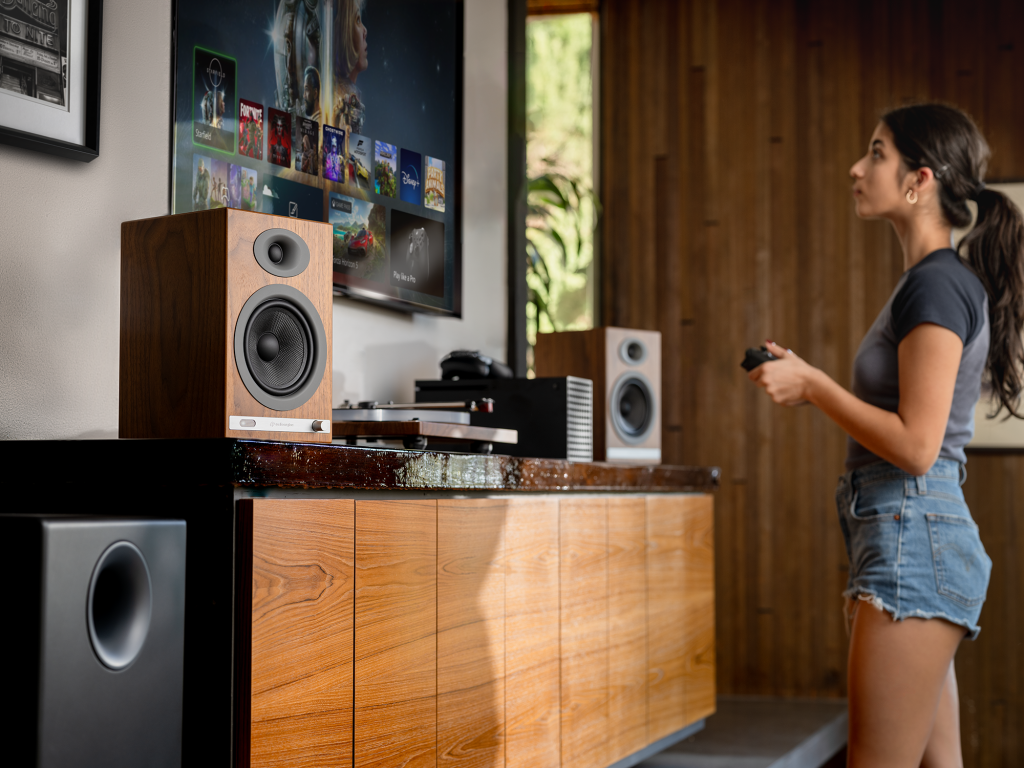
Getting the most from a subwoofer comes down to proper setup. The goal is balanced bass that works naturally alongside your existing speakers.
1. Find the right location. Start by placing your subwoofer near your speakers. Experiment with positioning because walls, corners, and room dimensions affect bass response.
2. Adjust the crossover frequency. The crossover determines which frequencies your subwoofer handles. Starting around 70–80Hz works for many speaker setups, but the ideal setting depends on your speakers.
3. Balance the volume. Increase the subwoofer level until the bass sounds full without overpowering vocals or instruments.
4. Test familiar songs. Play music you know well and listen for additional bass notes, stronger kick drums, and greater low-frequency detail.
A well-adjusted subwoofer should become part of the overall sound rather than drawing attention to itself.
Which Audioengine Subwoofer Is Right for You?
Audioengine offers two powered subwoofers designed for different listening spaces.
Audioengine S6 Powered Subwoofer
The compact S6 Powered Subwoofer features a 6-inch woofer and bass extension down to 33Hz. Its smaller footprint makes it a practical option for desktop setups, apartments, bedrooms, and smaller listening spaces.
Audioengine S8 Powered Subwoofer
The S8 Powered Subwoofer features an 8-inch woofer and reaches down to 27Hz, making it a strong choice for larger rooms or listeners who want deeper low-frequency extension.
Both models can complement Audioengine Home Music Systems, helping reproduce frequencies that smaller speakers may not deliver at full output.
Are You Getting 100% of Your Music?
Your speakers determine how much of the recorded frequency range reaches your ears.
If they can’t reproduce the deepest bass frequencies, you’re missing some of the musical content that makes your favorite songs sound complete.
A subwoofer can help recover that missing low-frequency range, giving instruments more body, drums more impact, and recordings a fuller tonal balance.
You could be missing up to 20% of your music. An Audioengine subwoofer can help you hear more of it.
Explore Audioengine powered subwoofers and find the right match for your music.